
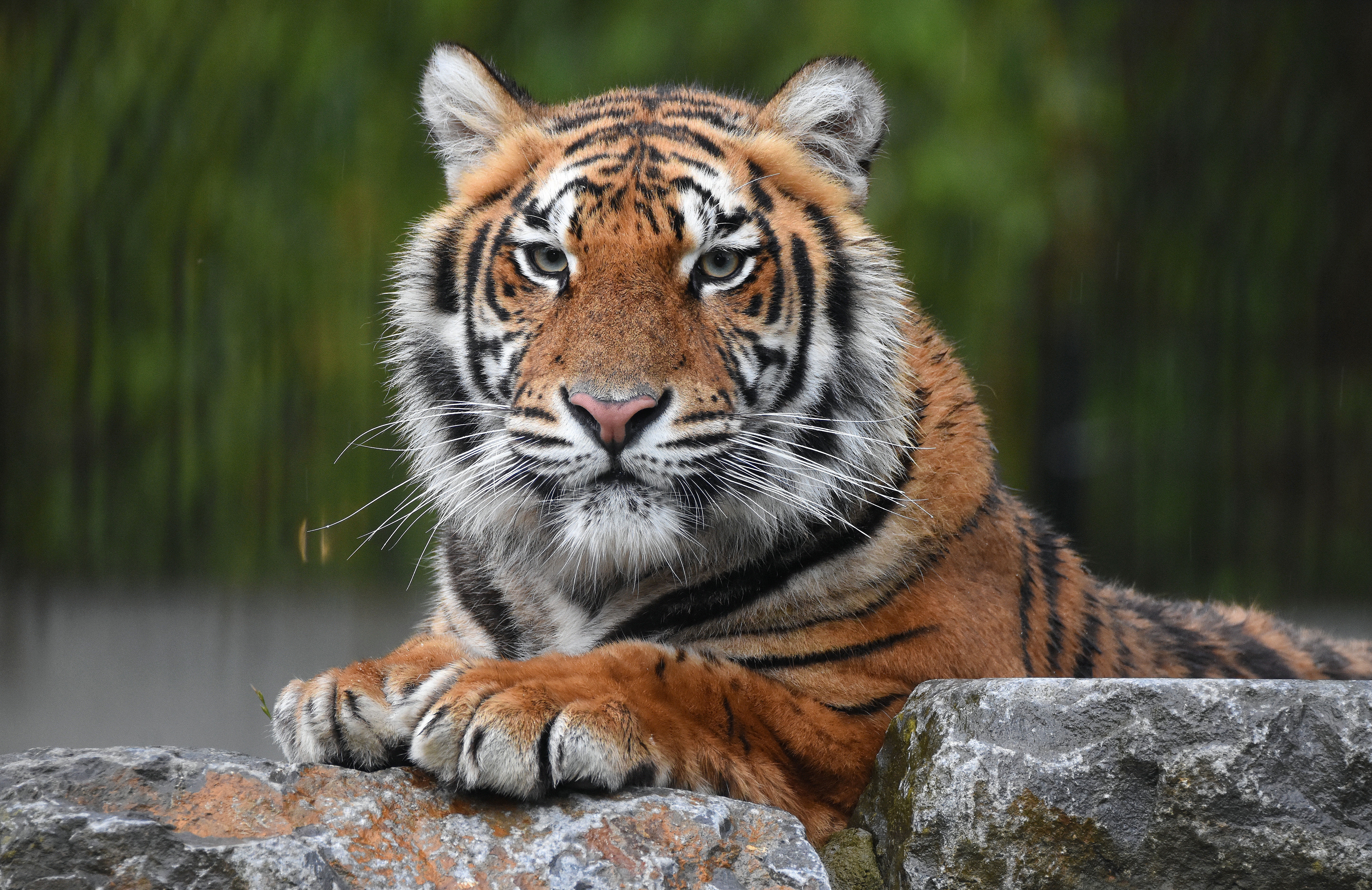
The bengal tiger (Panthera tigris tigris) is the largest living cat species and a member of the genus Panthera. It
is most recognisable for its dark vertical stripes on orange fur with a white underside. An apex
predator, it primarily preys on ungulates, such as deer and wild boar. It is territorial and
generally a solitary but social predator, requiring large contiguous areas of habitat to support its
requirements for prey and rearing of its offspring. Tiger cubs stay with their mother for about two
years and then become independent, leaving their mother's home range to establish their own.
The tiger was first scientifically described in 1758. It once ranged widely from the Eastern
Anatolia Region in the west to the Amur River basin in the east, and in the south from the foothills
of the Himalayas to Bali in the Sunda Islands. Since the early 20th century, tiger populations have
lost at least 93% of their historic range and have been extirpated from Western and Central Asia,
the islands of Java and Bali, and in large areas of Southeast and South Asia and China. What remains
of the range where tigers still roam free is fragmented, stretching in spots from Siberian temperate
forests to subtropical and tropical forests on the Indian subcontinent, Indochina and a single
Indonesian island, Sumatra.
The tiger is listed as Endangered on the IUCN Red List. As of 2023, the global wild tiger population
is estimated to number 5,574 individuals, with most populations living in small isolated pockets.
India hosts the largest tiger population. Major reasons for population decline are habitat
destruction, habitat fragmentation and poaching. Tigers are also victims of human–wildlife conflict,
due to encroachment in countries with a high human population density.
Project Tiger is a wildlife conservation movement initiated in India in 1973 to protect bengal
tigers.
During the tiger census of 2006, a new methodology was used extrapolating site-specific densities of
tigers, their co-predators and prey derived from camera trap and sign surveys using GIS. Based on
the result of these surveys, the total tiger population was estimated at 1,411 individuals ranging
from 1,165 to 1,657 adult and sub-adult tigers of more than 1.5 years of age.It was claimed that
owing to the project, the number of tigers increased to 2,603–3,346 individuals by 2018.In a
testimony to the success of Project Tiger, in 2023, the 55th tiger reserve in India was declared in
Dholpur-Karauli, Rajasthan, being the State’s fifth tiger reserve.
One of the primary reasons that tigers are endangered is poaching and illegal wildlife trade. Tigers
are often hunted for their pelts, bones, teeth, and claws, which are then sold on the black market.
In some cultures, tiger parts are believed to have medicinal properties or are used as status
symbols. This demand for tiger parts has led to a thriving illegal trade, with poachers hunting
tigers even in protected areas.
Habitat loss and fragmentation is another significant factor contributing to the endangerment of
tigers. As human populations continue to grow, forests are being cleared to make way for
agricultural land, palm oil plantations, infrastructure development, and timber extraction. This has
led to a rapid decline in the available habitat for tigers, with an estimated 95% of their
historical range lost.
Fragmentation of the remaining habitats also poses a threat, as it leads to smaller, isolated
populations of tigers that are more vulnerable to inbreeding, poaching, and conflicts with humans