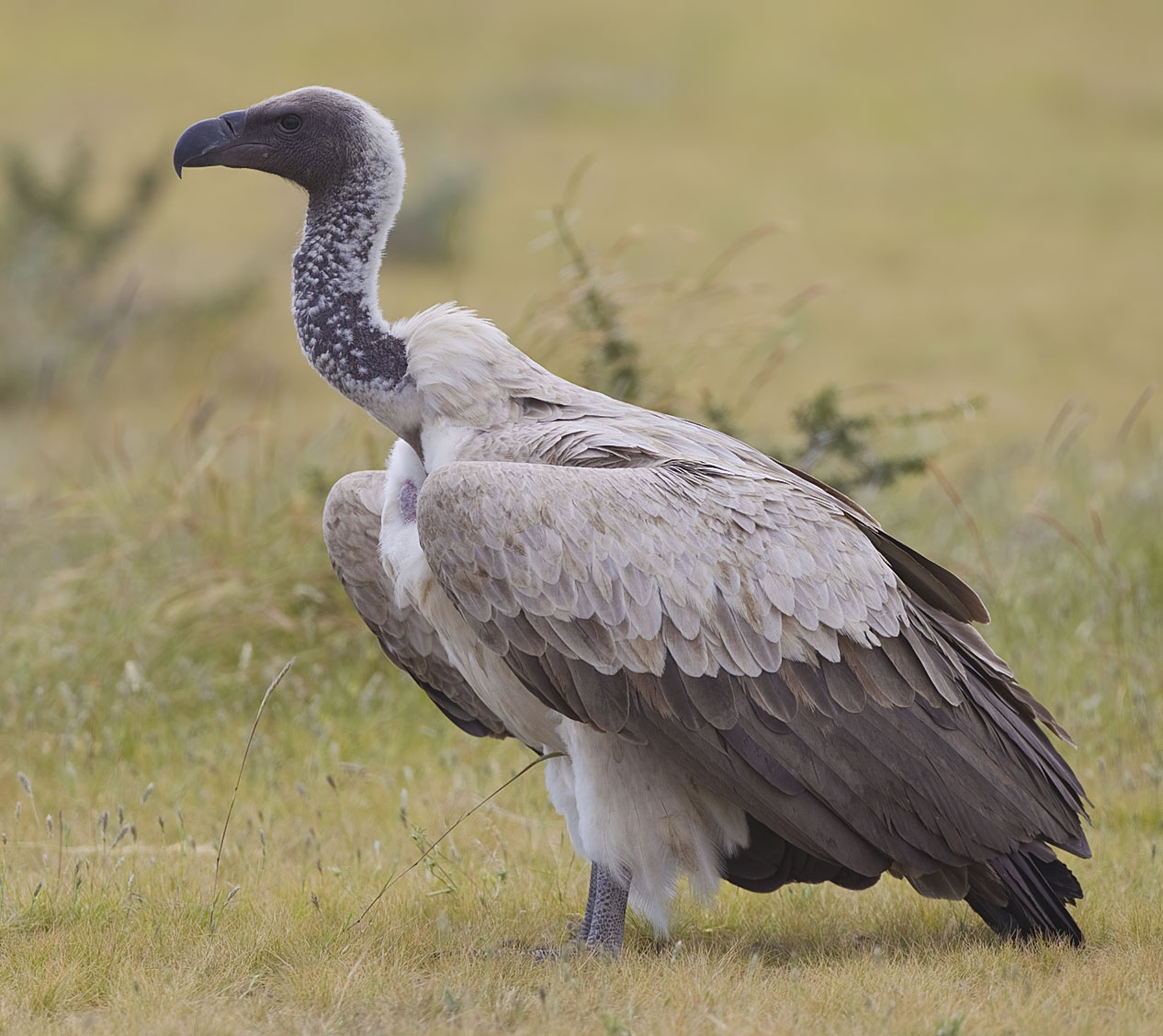
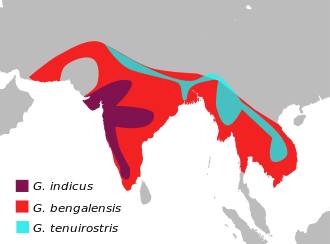
The white-rumped vulture (Gyps bengalensis) is an Old World vulture native to South and Southeast Asia.
It has been listed as Critically Endangered on the IUCN Red List since 2000, as the population severely declined.
White-rumped vultures die of kidney failure caused by diclofenac poisoning.In the 1980s, the global population was
estimated at several million individuals, and it was thought to be "the most abundant large bird of prey in the world".
As of 2021, the global population was estimated at less than 6,000 mature individuals.[1]
It is closely related to the European griffon vulture (Gyps fulvus).
At one time it was believed to be closer to the white-backed vulture of Africa and was known as the Oriental white-backed vulture.
The white-rumped vulture is a typical, medium-sized vulture, with an unfeathered head and neck, very broad wings, and short tail feathers.
It is much smaller than the Eurasian Griffon. It has a white neck ruff. The adult's whitish back, rump, and underwing coverts contrast with
the otherwise dark plumage. The body is black and the secondaries are silvery grey. The head is tinged in pink and bill is silvery with dark ceres.
The nostril openings are slit-like. Juveniles are largely dark and take about four or five years to acquire the adult plumage.
In flight, the adults show a dark leading edge of the wing and has a white wing-lining on the underside. The undertail coverts are black
Recently, 150 vultures were seen in the Valmiki Tiger Reserve (VTR), Bihar, which has prompted a vulture conservation plan in the protected region of VTR.India is home to 9 species of Vulture namely the Oriental white-backed, Long-billed, Slender-billed, Himalayan, Red-headed, Egyptian, Bearded, Cinereous and the Eurasian Griffon.Bearded, Long-billed, Slender-billed, Oriental white-backed are protected in the Schedule-1 of the Wildlife Protection Act 1972. Rest are protected under ‘Schedule IV’.Recently, the Ministry for Environment, Forests and Climate Change launched a Vulture Action Plan 2020-25 for the conservation of vultures in the country. It will ensure minimum use of Diclofenac and prevent the poisoning of the principal food of vultures, the cattle carcasses. The Vulture Safe Zone programme is being implemented at eight different places in the country where there were extant populations of vultures, including two in Uttar Pradesh. To upscaling conservation four rescue centres will be opened like Pinjore in the north, Bhopal in central India, Guwahati in Northeast and Hyderabad in South India. The ministry has now also launched conservation plans for the red-headed and Egyptian vultures, with breeding programmes for both. To study the cause of deaths of vultures in India, a Vulture Care Centre (VCC) was set up at Pinjore, Haryana in 2001. Later in 2004, the VCC was upgraded to being the first Vulture Conservation and Breeding Centre (VCBC) in India. At present, there are nine Vulture Conservation and Breeding Centres (VCBC) in India, of which three are directly administered by the Bombay Natural History Society (BNHS).
1.Poisoning from diclofenac that is used as a medicine for livestock.
2.Loss of Natural Habitats due to anthropogenic activities.
3.Food Dearth and Contaminated Food.
4.Electrocution by Power lines.
These species have declined over 95% since the mid-1990s due to feeding on livestock carcasses treated with
diclofenac, an anti-inflammatory fatal to Gyps vultures.
Biodiversity is being depleted worldwide at unprecedented rates, due to direct or indirect human actions.