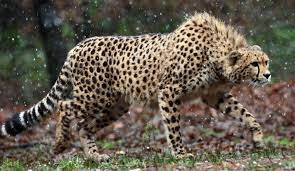
The cheetah is the world's fastest land mammal. With acceleration that would leave most automobiles in the dust,
a cheetah can go from zero to 60 miles an hour in only three seconds. Wild cheetahs are thought to be able to
reach speeds of nearly 70 miles an hour—although they can only sustain that speed for about 30 seconds.
These cats are nimble at high speeds, able to make quick and sudden turns in pursuit of prey.
There’s some debate over whether cheetahs are “big cats.” Some scientists argue that the term only refers to
cats that are capable of roaring: lions, tigers, jaguars, and leopards. Cheetahs can’t roar, though they can
they purr. Still, conservation groups tend to embrace the wider definition of “big cats”
that also includes snow leopards and cougars.
Even though their speed makes them fearsome hunters, cheetahs are the most vulnerable of the world’s big cats.
The International Union for Conservation of Nature currently lists the cheetah as vulnerable to extinction.
However, in recent years, scientists have argued that cheetahs should be considered endangered instead,
pointing to sizable losses in cheetah populations. There are fewer than 7,000 adult cheetahs remaining in the wild.
Cheetahs are famous for their tawny coats covered in black spots, each arranged in a unique pattern to help the animals
identify one another. Bold black stripes streak like tears from the inner corners of their eyes down to both sides of
their mouths, and the ends of their bushy tails are encircled by black rings. As the only big cat with a semi-retractable
claw—rather than the fully retractable claws that help lions tear flesh and climb
trees—cheetahs are the sole member of the genus Acinonyx.
India is going to be home once again to the majestic presence of cheetah, the world’s fastest land animal. Yes, the Government of India has decided to reintroduce cheetahs, under the 'Action Plan for Introduction of Cheetah in India’. Unveiling the action plan, Union Minister for Environment, Forest and Climate Change, Shri Bhupender Yadav informed that Prime Minister Shri Narendra Modi is keen on the protection and conservation of seven major big cats including Cheetah. “Project Cheetah aims to bring back independent India’s only extinct large mammal – the cheetah. As part of the project, 50 cheetahs will be introduced in various National Parks over five years.” Discussions to bring the cheetah back to India were initiated in 2009 by the Wildlife Trust of India. Experts from across the world, officials of the Government of India including Ministry of Environment, Forests and Climate Change and representatives of the state governments met and decided to conduct site surveys to explore the reintroduction potential. Former cheetah range states, i.e., Gujarat, Rajasthan, Chhattisgarh and Madhya Pradesh, were prioritized.
There are a number of threats facing cheetahs today, including habitat loss, prey loss, illegal trade, and human-animal conflict. The cheetah population's lack of genetic diversity is linked to low birth rates and is another cause for concern. Cheetahs face extinction pressure from climate change, hunting by humans, and habitat destruction, which is reducing the size of their populations.